
Potentiality Explored No.10
The tides of our minds.

Recently, I spent time along the coast of Normandy and Brittany. The tidal range there is extraordinary - some of the highest in the world, reaching up to 12 metres. That’s the equivalent of a four-storey building rising and falling every six hours.
Mont Saint-Michel may be the best-known landmark, but really, the whole coastline is shaped by this dramatic rhythm. It’s a landscape that changes constantly: bays emptying into vast sands and then filling back with waves from the ocean’s depths; boats in village harbours alternately resting on their sides and then floating tall with sails unfurled.
Watching this cycle in Dinard, I began to realise that these tides offered me a personal way of thinking about how I manage my ups and downs. That I can use this natural phenomenon as a way to inspire me in a practical way to navigate my moods, energy, and my reactions to things I feel I have little control over.


Photos taken in Dinard in September 2025.
As I took photographs of the coastline, it really struck me how useful these visual movements of the water, clouds and birds are when you are looking at creating a new perspective on what life comes up with. They turn something familiar into a lens for reflection. What I found with the tides is that they translated into states of mind, interlocked states of mind or in other words, they could become for me a way to manage change in how I interact with my world. These tides can help me explore how I move from stillness to action, from high activity to reflection and how each stage has value.
Of course, I’m not the first to see tides as a useful parallel to describe how one handles life. Writers, psychologists, and coaches have long drawn on nature’s rhythms to make sense of our inner worlds. But what struck me in Dinard was how immediate and personal the tides felt. Standing there, watching the boats lie stranded and then slowly lift back into motion, I realised each of us has our own inward tidal story, our own way of rising, pausing, receding and beginning again. Does that make sense to you?
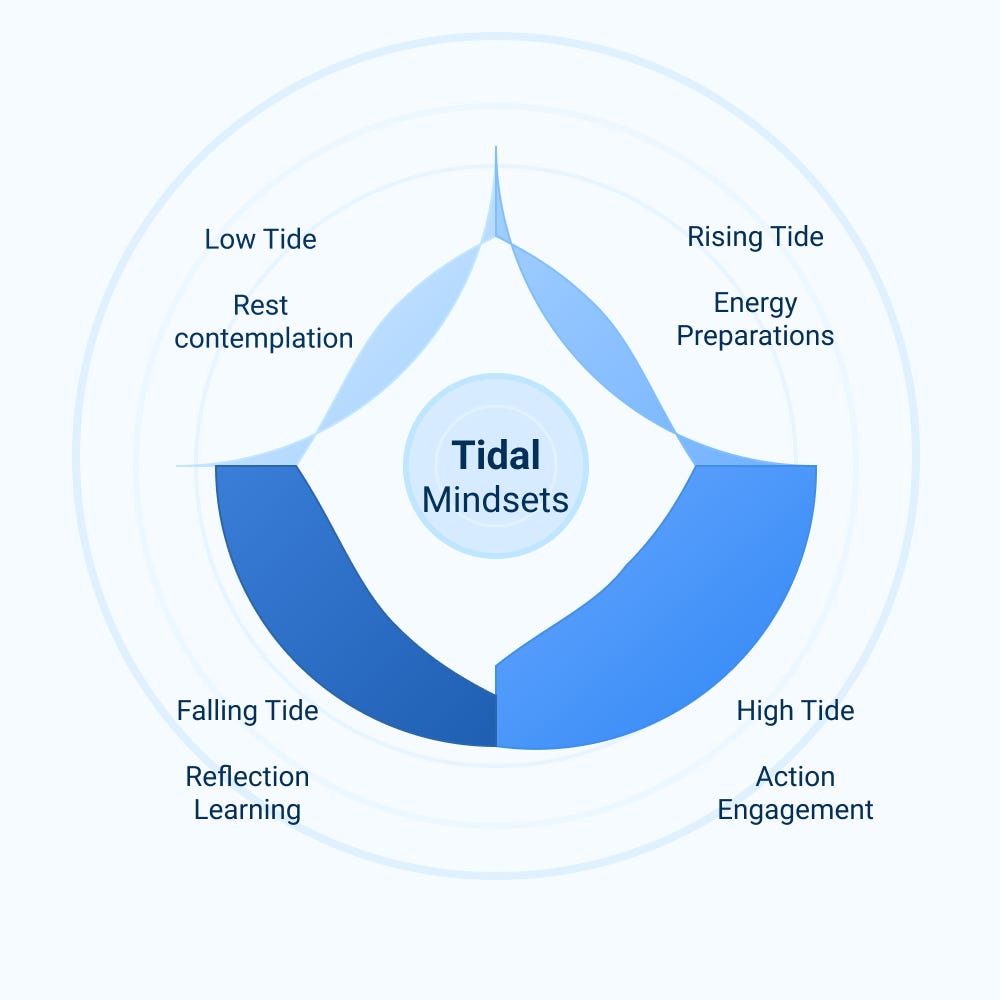
Here’s how I’ve mapped it into five stages so that I can identify where I’m at when something comes up that needs my attention. Where am I when this happens? I could be in any one of these stages:
Low Tide – My boat is lying on the sand, not moving but not useless either. I am in a contemplative stage. It’s a time for rest, reflection and letting my thoughts settle like birds on the hulls. I’m noticing the light, the winds, the smells of the sea and the beach.
Rising Tide – Activity begins. As the water comes in, my keel starts to straighten out, I am noticing what is coming up, what is of potential concern and needs my attention. My boat steadies upright and I can start to unfurl my sails as I check the winds, currents and start to plot where I want to go and what course I should follow. This is the planning stage where ideas formed in quiet begin to take shape.
High Tide – Now is the time for action. All hands on deck, as mariners say! I am fully afloat and the winds and currents demand my full attention. My energy is high and now that my plan is being implemented, this is where I need to be careful of potential risks - unseen rocks, other boats - to identify them and act to avoid flipping into an overwhelm situation and potentially capsizing! My navigation here requires focus and resilience.
Receding Tide – The tension eases and momentum slows. What was hidden beneath the waves is revealed again. The bottom sands have shifted a little and this is a time for me to learn and integrate, to notice what has changed around me.
Returning to Low Tide – Reflection deepens. I hope to see clearly what’s changed since the last cycle and prepare for the next one.
Used as a coaching tool, the tides reminded me that we’re not meant to operate at “high tide” all the time, that my life moves in cycles. By recognising where in this tidal cycle I am finding myself, I might be able to choose how best to use my energy.
At low tide, reflection and planning are more fruitful than forcing action.
At rising tide, it’s time to prepare, align my support systems and set direction.
At high tide, bring my full resources and courage to bear but stay mindful of overwhelm.
At receding tide, pause, learn and consolidate.
This exercise of reflection has helped me to realize that it’s OK not to operate constantly at 100% efficiency and it’s actually not a bad idea to let go of that need. I’ve figured that to use my tidal cycle in a harmonious way will result in a more positive mindset about handling what I have little or no control over and to better manage aspects of life where I do have agency. Just as the tides are ever-changing and influenced by the pull of the moon and sun’s gravity, so too are our inner rhythms.
If everyone has their own inner tide, the question is: how might you listen for yours - and what could change if you began to sail with it rather than against it?
Written by Edward Jospé
At TopHat Discovery, we love a metaphor and we’d be interested in hearing from you. What are your favourites? Do you use them often to describe how you are feeling about an upcoming project? Let us know. Contact us here.
TopHat Discovery Update.
Day-Retreat for coaches. 8th of November in South Park, London SW6. From 10 till 4, a day of reflection, re-charge, reignition and resolve. More information here.
Our group coaching programme, Navigating Change 2.0 Resilience in Action is into its 4th week; you can attend just the one - bound to be beneficial! More information here.
For coaches wishing to practice coaching methods, to receive coaching and to observe coaching sessions, for group coaching and peer-to-peer sessions, why not join the Be a Better Coach Programme. More information here.
TopHat Discovery Coaching Services.
Thanks @Edward I have been pondering the picture of the high and low tides. It made me think how at low tide thinks can seem a bit desolate and quiet; the boats lying on their sides etc. But at the same time there will be birds benefitting from the life that emerges at low tide picking over the sand and walkers with their dogs and great views. It also made me think how my metaphorical high tides or low can impact on others. Sometimes they may threaten to overwhelm and at other times the opposite. Very thought provoking. Thanks!