
Potentiality Explored No. 19
Coaching, like community, depends on conversations to shape belonging and unlock potential.

I’ve been thinking about communities and coaching and what they have in common.
I’m not entirely sure yet but there’s something I keep circling back to and that’s they both depend on conversations. Or at least, it starts there.
Communities, before we even know what they are
We’re born into communities before we ever have language for them. Family, school, friends in the neighbourhood. The small, ordinary worlds that quietly shape who we become.
I grew up in Brussels, which was, in many ways, a privileged environment with nothing dramatic or threatening in the background. I lived the normal rhythms of childhood, playgroups, school and sports, friendships forming and dissolving, the first sense of belonging outside the family. At the time, I didn’t think of any of it as “community”. It was just life.
But looking back, I can see how much of it was happening through conversation. Not formal conversation but simple and constant exchanges to try things out, to be seen and corrected. To be included and sometimes not.
That was probably my first experience of how people are shaped together, not separately.
And then later, something else appears
As I got older, I started to understand that communities aren’t just something we drift through. They matter more when things get difficult.
My father’s family history during the Second World War made that very clear. When everything becomes uncertain for them, it was often relationships and connections that determined what was possible. Who you can call? Who can you trust? That stays with me to this day..
Community isn’t only about belonging. It’s also about continuity and sometimes survival.
The strange thing about communities
Over time, communities change shape.
Friends from school coalesce. Work colleagues join up for socials, strangers get together in learning support groups, neighbours join up to talk about road safety, environmental projects, “shop-local” campaigns and so forth.
Different groups emerge: online spaces appear and disappear, some last and some don’t even get off the ground.
But what I keep noticing is this: they’re all held together by conversation. Not the big formal kind but the small kind. The “how are you really doing? …I’ve been thinking about what you said… and ... how can I help you with this?” kind. The coaching community I belong to is a wonderful example of how dialogue enlivens our sense of belonging.
In a way, communities are just conversations that keep going long enough to matter.
Coaching, when I first met it
At first it was about helping people. Supporting reflection. Creating space for change. Look to the future, not the past. But over time, something shifted and now my coaching community has become part of my daily life. Having open-minded conversations matters to me as a human.
In a community, we’re held by many conversations at once - friends, colleagues, chance encounters, family, all overlapping.
In coaching, that becomes one relationship. My client and I are in a conversation that is allowed to go deeper than most others because we have the space to go there. The exchange is as important although it’s more focused.
Why stepping into coaching feels… different
I’ve noticed that some people I’ve talked to are genuinely interested in coaching when I speak of it; and even enthusiastic, and still…they hesitate. It may be because they are nervous about having to let go of something - the perception being that a coach will insist on removing a mask when in reality a coach will simply encourage talking and to ignore the noise and to let go. The direction in which you then travel is yours to take.
And when that courage happens, things become more visible. Patterns, choices, avoidances and assumptions emerge in a clearer way. And that clarity can make one feel exposed.
In a community, responsibility is shared across many conversations. In coaching, it becomes more concentrated, more direct. That can be helpful but it can also feel like a step into the unfamiliar.
So I don’t think the hesitation is unusual. I think it makes sense.
Where communities and coaching overlap
What I keep coming back to is that communities and coaching are not really separate but different expressions of the same need.
Both create space for people to think out loud. Both shift how we see ourselves through conversation. Both help us notice what we might otherwise miss on our own.
The difference is structure. Communities are distributed and coaching is focused.
Communities give us breadth and coaching gives us depth.
A final thought (for now)
Maybe we don’t only change because we decide to change.
Maybe we change because we find ourselves inside conversations that don’t let us stay exactly as we were. Communities do that in their own way. Coaching does it in a more intentional way. And perhaps they’re not so different after all.
Just different ways of doing the same very human thing: thinking, speaking, listening and the discovery of the new “us” - through other people.
This month’s newsletter was written by Edward Jospé, co-founder and director of TopHat Discovery CIC
We welcome your comments:
Please get in touch if you’d like to know more about coaching:
Upcoming group learning opportunity
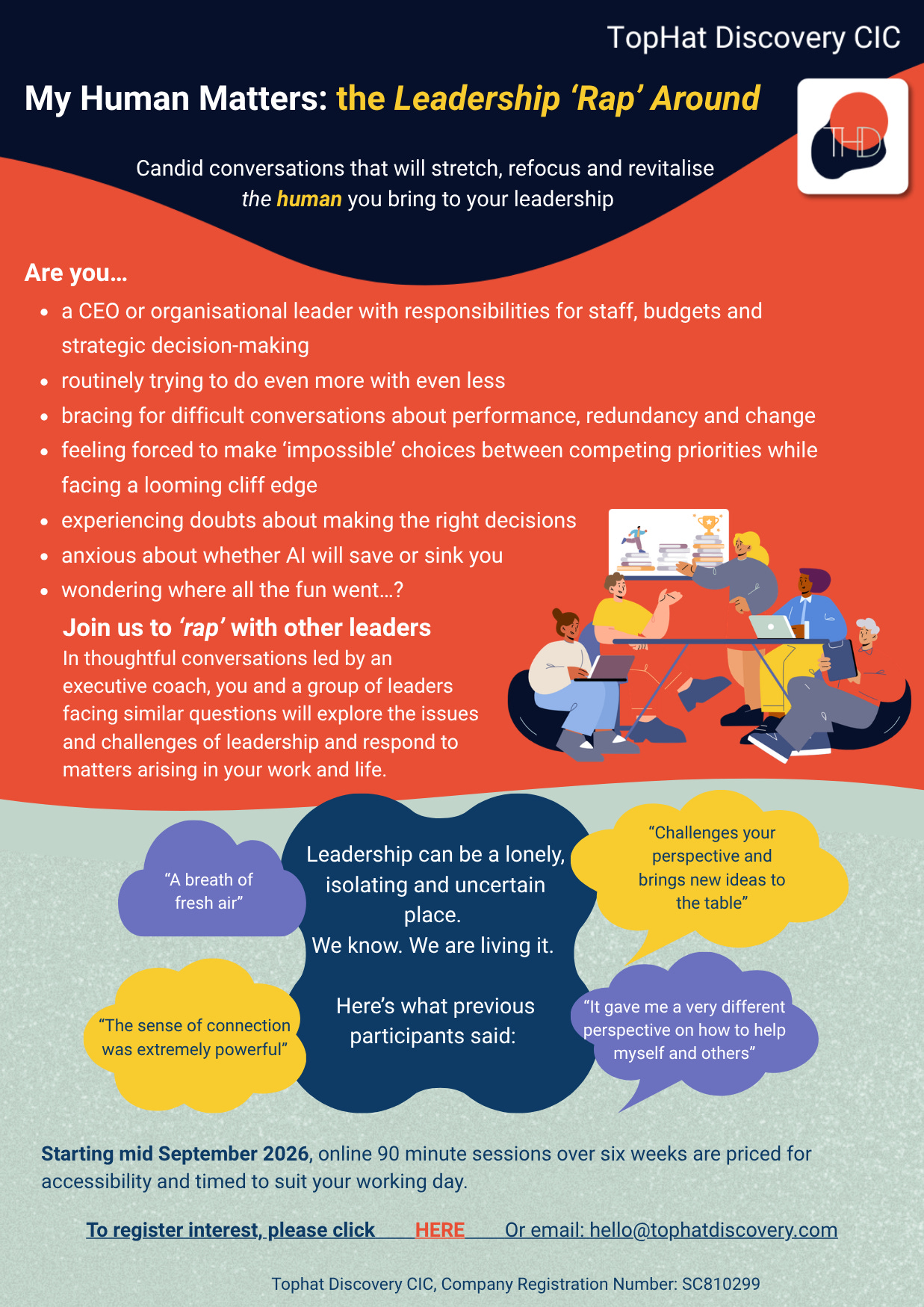
Attention Leaders! Join our “Rap’ Around leadership group sessions to breathe some fresh air into your leadership as you find new perspectives and rediscover being truly human. Starts September so CLICK HERE to find out more and get it into the diary!
CLICK HERE To register your interest